I Turned It Off. And Then Back On.
What Nature Can Teach Us About Apparent Opposites
It had been an incredible journey. My wife and I had spent weeks travelling through Western Canada, moving from landscapes that made us feel wonderfully small to places where we wished we could have stayed just a little longer. Mountains, forests, lakes. We had seen so much and covered so much ground. And now we were in Vancouver, our final stop before the flight home.
A long, tiring journey lay ahead. We both needed one more good night’s sleep. Leaving well rested would not make saying goodbye to Canada any easier, but it might make the hours on the plane more bearable.
There was just one problem: our hotel stood between two busy roads.
The windows were closed and seemed well insulated. Still, the traffic remained clearly audible: a car approaching, passing, fading into the distance. Then the next one. The kind of sound you barely notice during the day, but that insists on making itself heard as soon as you want to sleep. Vancouver, apparently, had no intention of closing its eyes with us.
There was a device in the room that I had never seen before. It looked like a small speaker, except that it did not play music. When I switched it on, it produced a continuous, monotonous hiss.
This was supposed to help us sleep.
It struck me as an odd proposition. Noise was already the problem. Apparently, the solution was even more noise. I tried it for a moment, became irritated by the hiss and switched the device off again.
The cars returned immediately.
After a while, I switched it back on. The hiss was still there, but gradually I began to get used to it. Eventually, I fell asleep. And I slept well.
Looking back, that small incident stayed with me. Among all the impressive memories of Canada, a softly hissing box had somehow earned its place. I had been searching for silence. What I needed was rest. Apparently, the two were not quite the same.
The steady sound probably made the passing cars less noticeable. The traffic did not disappear; it simply stood out less sharply against the background. This is known as sound masking. A small study in a noisy urban environment found that white noise could improve sleep. That does not tell us exactly what worked for me, but it makes the experience less mysterious. [1]
The question it raised went further: how often do we dismiss something as part of the problem when, under different conditions, it might also contribute to the solution?
For a surprising answer, we need to leave the hotel. And go underwater.
An Unexpected Ally
Imagine a fish moving through the water in search of tiny prey. The American paddlefish has a remarkable instrument for the task: a long, paddle-shaped snout equipped with receptors that can detect weak electrical signals. Even very small prey produce such signals.
The trouble is that some signals are too faint to notice. They remain below the detection threshold, like someone knocking so softly on your door that you do not get up.
What would you do to help the fish? My first thought would be to remove interference and make sure nothing obstructs the weak signal.
Researchers did something that seems to contradict that intuition. They added electrical noise to the water. With the right amount of noise, the paddlefish was able to detect prey over a greater distance. [2]
How is that possible? The noise creates small fluctuations. Some of these give the weak signal just enough of a boost to cross the detection threshold. It is as though the soft knock occasionally receives a helping push. Too much noise does not help: the signal then becomes difficult to distinguish again.
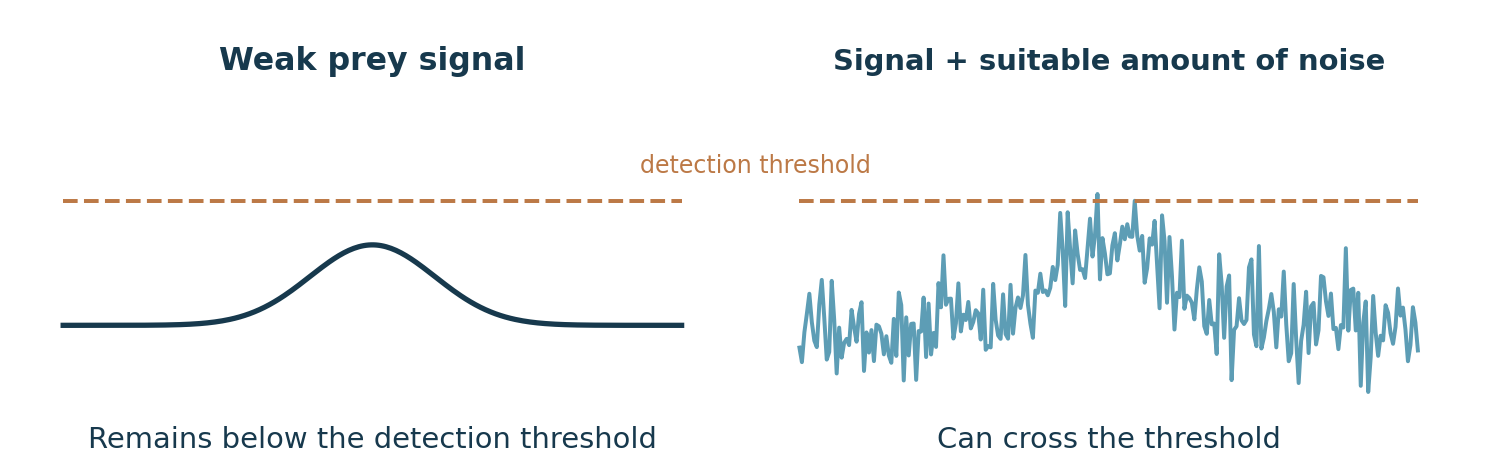
This is not what happened in our hotel room. There, noise probably helped me hear something less clearly. Here, it helps the fish perceive something more clearly. Two different mechanisms, with the same invitation to reconsider our first reaction: is noise always an enemy?
This is not yet a case of two poles strengthening each other. It is an opening. A property acquires its meaning through the conditions in which it operates. Once you begin to see that, you also start looking differently at a shell.
The Strength of a Weak Connection
A shell seems to make a convincing case for hardness. If you want to protect a vulnerable body, a solid exterior appears to be the obvious solution.
But think of a plate slipping from your hands. While you are holding it, it feels solid and unyielding. The kitchen floor reveals how little that says about its ability to survive an impact. Hard can also mean brittle.
A mollusc therefore faces a difficult task: it must create protection that resists force without cracking too easily under pressure.
Nacre, the iridescent inner layer of certain shells, shows how this can be done. Under a microscope, it reveals a structure of hard mineral tablets separated by thin organic interfaces. Imagine a tiny brick wall made of solid bricks and joints that can yield slightly.
Now imagine a crack appearing somewhere.
In a brittle block, it may continue straight through the material. In nacre, it meets interfaces along which it can change direction. The tablets can also move slightly in relation to one another. This helps absorb energy and makes it harder for the crack to continue. Research on three types of nacre identified these relatively weak interfaces as an important source of the material’s resistance to fracture. [3]
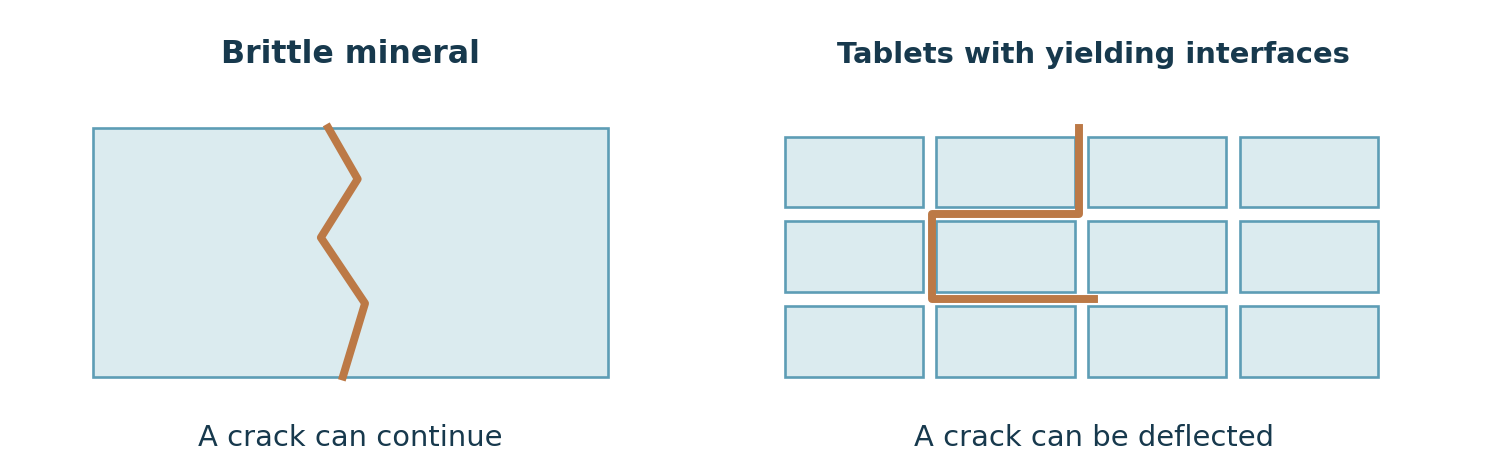
I find that a beautiful idea. Something we might describe as a weakness when viewed in isolation helps the whole structure endure.
The hard tablets do not become softer, and the yielding interfaces do not need to turn into hard tablets. Their different properties remain necessary. The way they are connected makes a protective whole possible.
I inevitably think of organisations that try to become stronger by tightening everything. More rules, more control, less room to move. Sometimes firmness is necessary. But where are the connections that can yield before something breaks? What kind of flexibility helps people sustain their commitment when pressure increases?
A shell does not offer management advice. It does make the question harder to ignore.
Stopping in Order to Continue
Moving from a shell to a bacterial colony may seem like a considerable leap. Yet there we encounter a familiar problem: what works well on the outside can create difficulties within.
The bacterium Bacillus subtilis can live in a connected community known as a biofilm. The cells on the outside are well positioned to receive incoming nutrients. They get first access to whatever arrives. The cells at the centre must make do with whatever reaches them.
At the same time, that outer layer provides protection. The inner cells lie sheltered behind it. But if the cells at the edge consume too many nutrients, the centre may be left without enough. The protective layer then becomes an obstacle as well.
It is easy to see that simply growing faster will not solve the problem.
Researchers discovered something else: the growth followed a rhythm. The metabolism of the outer and inner cells was connected in such a way that growth periodically paused. During these pauses, more nutrients could reach the sheltered cells inside. When exposed to a chemical attack, this rhythm helped the community survive. [4]
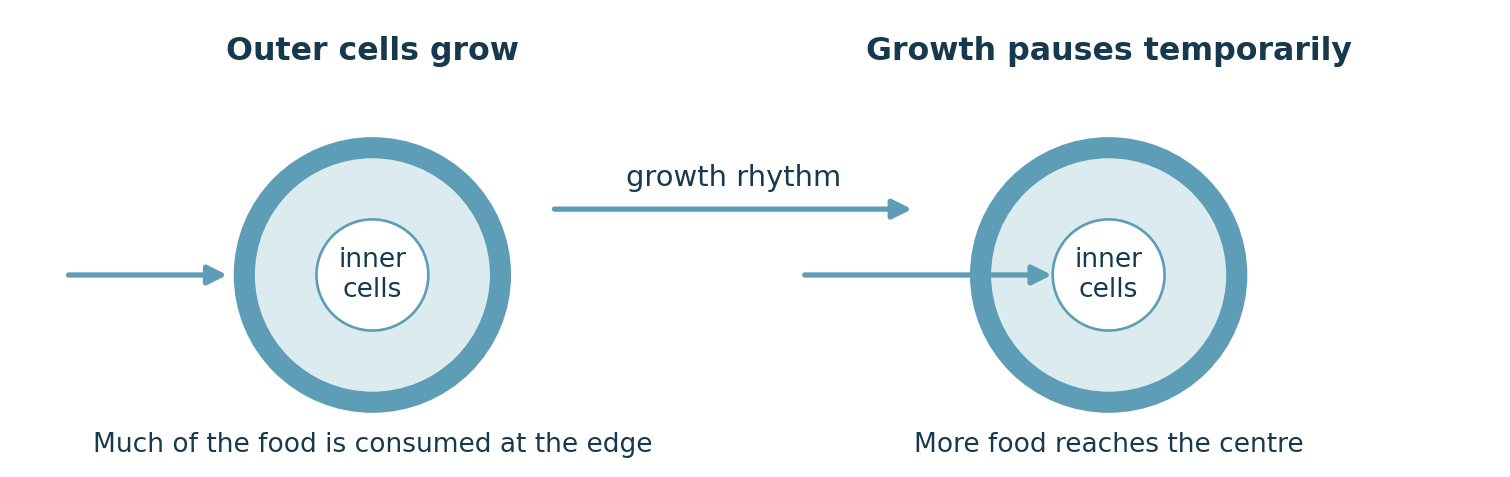
No bacterium calls a meeting and announces that the centre deserves its share. The rhythm emerges from their interdependence. That is precisely what makes it so interesting: the relationship between the parts produces a form of coordination that matters for their survival.
Growth and protection are not both maximised. What the rhythm does is prevent one necessary function from undermining the other.
Perhaps this resonates with me because we had spent so much of our journey on the move. You want to continue, see one more place, travel somewhere else. But if you want to keep enjoying a journey, you also need room to catch your breath. That is a human association, not a biological conclusion. It does help me understand why a pause can be more than lost time.
Sometimes we search for a state of balance in which everything must happen at once. A bacterial colony reveals another possibility: a rhythm in which different needs each receive their moment.
What the Other Receives Matters
Meanwhile, another story is unfolding beneath our feet. Fungi living around plant roots can supply mineral nutrients from the soil. The plant can offer something the fungus benefits from: carbon compounds produced with the help of sunlight.
It sounds like an elegant exchange. You have something I need. I have something you need.
But that alone does not guarantee cooperation. Giving everything away would benefit neither partner. And why continue investing in a partner that offers little in return?
Researchers found that plants and mycorrhizal fungi can adjust the exchange from both sides. Plants allocated more carbohydrates to fungal partners that provided more. The fungi, in turn, delivered more nutrients to roots from which they received more carbohydrates. [5]
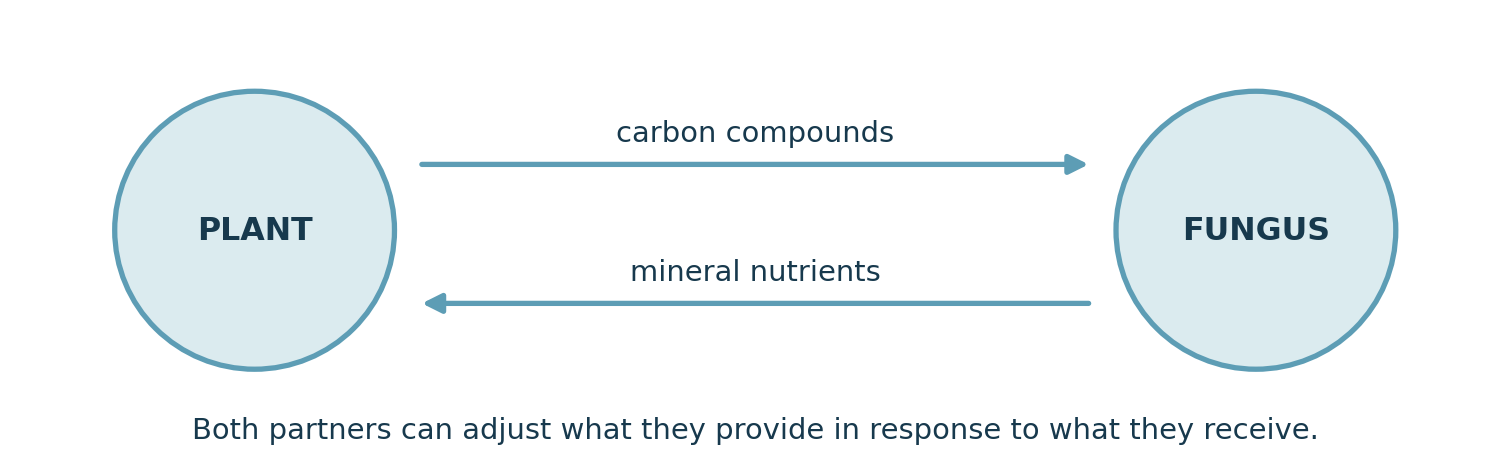
There is no need to turn this into an underground fairy tale in which everyone selflessly takes care of everyone else. What actually happens is at least as fascinating. The partners can respond to what they receive from each other. Contributing to the other can therefore also support one’s own access to essential resources.
The tension here lies between self-interest and mutual interest. The plant and the fungus are not themselves opposing poles. Their needs differ, and their interests do not entirely coincide. Yet the exchange can develop in a way that benefits both.
This brings me to a question that also matters above ground: how can we organise cooperation so that people can strengthen their own future through it? Reciprocity then acquires a concrete foundation. The relationship remains valuable because both sides find something essential in it.
Switching It Back On
This is what draws me to biomimicry: looking closely at how life responds to challenges and exploring which principles might inspire us. Nature offers much more than beautiful forms. It reveals connections, rhythms and ways of exchanging value.
It also contains competition, exploitation and failure. We cannot derive a moral handbook from it. But we can learn to look more attentively at situations in which different properties combine to make something possible.
This is where biomimicry meets Synergetic Thinking for me. In nacre, the connection between hardness and flexibility matters. In bacteria, a rhythm helps reconcile competing needs. In plants and fungi, reciprocal influence sustains exchange. These are different clues for transforming tension into lasting value.
Before trying to eliminate a counterforce, we can pause. What does it contribute? Under which conditions does that contribution become valuable? What could we change about the way both sides meet?
Apparently, I first had to travel to the other side of the world, enter a hotel room, switch on a device, switch it off in irritation and then give it one more chance.
Outside, the cars kept moving. Inside, I fell asleep.
Sources
- Ebben, M. R., Yan, P. & Krieger, A. C. (2021). “The effects of white noise on sleep and duration in individuals living in a high noise environment.” Sleep Medicine, 83, 256–259.
- Russell, D. F., Wilkens, L. A. & Moss, F. (1999). “Use of behavioural stochastic resonance by paddle fish for feeding.” Nature, 402, 291–294.
- Dastjerdi, A. K., Rabiei, R. & Barthelat, F. (2013; online 2012). “The weak interfaces within tough natural composites: Experiments on three types of nacre.” Journal of the Mechanical Behavior of Biomedical Materials, 19, 50–60.
- Liu, J. et al. (2015). “Metabolic co-dependence gives rise to collective oscillations within biofilms.” Nature, 523, 550–554.
- Kiers, E. T. et al. (2011). “Reciprocal rewards stabilize cooperation in the mycorrhizal symbiosis.” Science, 333, 880–882.
The biological findings come from the cited publications. Their connection with Synergetic Thinking is an interpretation offered for inspiration, not a conclusion examined in those studies.